


Project Overview
Santa Felicia Dam has served as an important part of Ventura County’s water infrastructure since 1955, supporting regional water supply and groundwater recharge. To ensure the dam can continue operating safely and reliably for decades to come, United Water Conservation District is advancing the Santa Felicia Dam Safety Improvement Project (SFD SIP).
The project will modernize critical dam infrastructure to address seismic risk, extreme storm events, and long-term sediment accumulation while protecting the regional benefits Lake Piru provides.
Santa Felicia Dam has operated for more than 70 years, but dam safety standards and our understanding of seismic and extreme storm risks have evolved significantly since it was built. Modern improvements are needed to ensure the dam continues meeting current safety requirements while maintaining reliable reservoir operations.
The Santa Felicia Dam Safety Improvement Project (SFD SIP) strengthens the dam’s most critical operating systems to address:

Seismic Risk

Sediment Accumulation

Storm Event Management
Together, these improvements protect downstream communities while preserving the long-term
functionality of Lake Piru Reservoir as a regional water supply and recharge asset.
What Are We Doing? SFD SIP consists of three integrated improvements
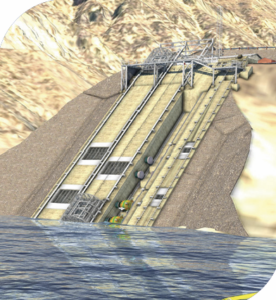
Seismic-Resilient Outlet Works
Unlike the existing configuration where the outlet works run through the dam embankment, the new system will be routed through bedrock on
the dam’s east abutment, eliminating the risk that seismic deformation could compromise its structural integrity or functionality.
The upgraded multi-level intake configuration also addresses long-term sediment accumulation, preserves operational flexibility, and allows for
selective withdrawal of reservoir water at various elevations. Additionally, the construction phase creates the operational conditions needed to
evaluate sediment removal options that could potentially recover 2,700 acre-feet of lost reservoir storage capacity.
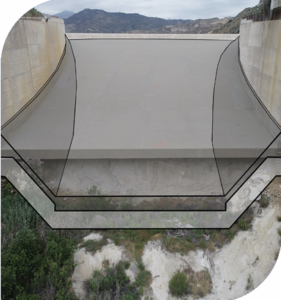
Spillway Improvements for Storm Events
The Division of Safety of Dams (DSOD) requires Santa Felicia Dam’s spillway to pass an inflow design flood of 220,000 cubic feet per second (cfs). The existing spillway falls short at 146,000 cfs. To meet this requirement, the spillway chute will be lowered by 15.5 feet, reinforced with a new chute slab, side walls, and rock anchors, and protected at its downstream end with a concrete cutoff wall to prevent scour.
The existing ogee spillway crest and walls will be preserved where feasible. The embankment dam crest will also be raised by 6.5 feet using a mechanically stabilized earth wall, ensuring that extreme storm
flows are directed to the spillway rather than over the dam.
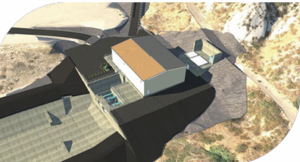
Hydropower Facility
The project updates the existing 1.4-megawatt hydropower facility, allowing continued renewable energy generation as part of normal reservoir operations. Because Santa Felicia Dam operates a hydropower facility, it is licensed and regulated by the Federal Energy Regulatory Commission (FERC).
Improvements Visualized: 3D Modeling
What’s At Stake?
The Santa Felicia Dam Safety Improvement Project is about more than upgrading infrastructure. The continued operation of Santa Felicia Dam supports water reliability, groundwater management, public safety, and community resources throughout the region.
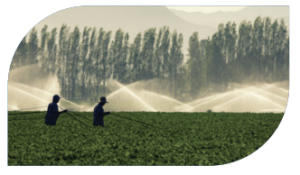
- Agricultural, municipal, and industrial users across the valley and the Oxnard Coastal Plain
- Groundwater recharge for overdrafted basins and aquifers throughout the region
- Imported State Water Project supplies storage
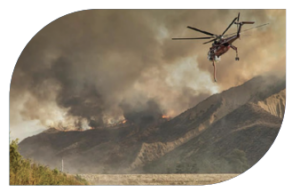
- Wildfire response, firefighting support, and post-fire water quality protection
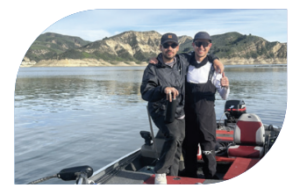
- Camping, boating, fishing, and hiking at Lake Piru, an outdoor haven for Southern California families
Maintaining all of this requires meeting modern regulatory standards set by FERC and DSOD. The Santa Felicia Dam Safety Improvement Project ensures the dam can continue doing what it has always done reliably and safely, while positioning the region for the challenges ahead.
Project Benefits
Increases dam resilience against seismic events and extreme storm flows, protecting the operational continuity of a critical regional water supply asset.
Secures continued operational flexibility for sustainable groundwater recharge and direct water delivery within United Water’s service area, helping address overdrafted groundwater basin conditions across the region.
Provides operational flexibility and redundancy, allowing selective withdrawal of reservoir water at various elevations for water quality management while accommodating future sediment level rise.
Positions United Water to evaluate sediment removal options that could potentially recover thousands of acre-feet of lost reservoir storage capacity.
Modernizes the dam’s hydropower facility, supporting continued generation of clean, low greenhouse gas energy in Southern California.
Preserves access to Lake Piru’s recreational amenities, including camping, boating, fishing, and hiking, supporting community wellness and the local outdoor economy that depends on continued reservoir operations.
Creates new construction job opportunities, with an estimated daily need for 37 to 46 skilled laborers.
Protecting these benefits requires Santa Felicia Dam to continue meeting modern safety and regulatory standards. The Safety Improvement Project is designed to ensure these resources remain available for generations to come.
The Cost of Inaction
The risks facing Santa Felicia Dam present two paths, and both lead to the same devastating outcome if this project does not move forward.
In the unlikely event of a dam failure, the consequences are catastrophic. But failure is not the only risk. FERC and DSOD have the authority to require decommissioning of Santa Felicia Dam if regulatory requirements are not met.
That outcome, while less dramatic, would be equally devastating. Lake Piru disappears. Water supply infrastructure built over decades vanish. Groundwater recharge efforts suffer significantly. 80,500 acre-feet of storage is gone. A recreational resource is lost. And the cost of decommissioning alone could rival or exceed the cost of the improvements needed to prevent it, as California has already seen with projects like the $532 million Potter Valley Dam decommissioning effort.
The Santa Felicia Dam Safety Improvement Project is a choice between protecting everything the dam provides, or losing it all.
Potential Santa Felicia Dam Failure Impacts
Santa Felicia Dam is located in a moderately active seismic region of Southern California and is classified as an extremely high-hazard dam by the California Department of Water Resources Division of Safety of Dams (DSOD) and as a high-hazard facility by the Federal Energy Regulatory Commission (FERC). These classifications reflect the large population located within the dam inundation zone, not the condition of the dam itself.
The consequences of a dam failure, while highly unlikely, would be severe. Floodwaters could rapidly inundate downstream communities, including large portions of Ventura County and Naval Base Ventura County, threatening lives, property, and critical infrastructure. These potential impacts underscore the importance of the Santa Felicia Dam Safety Improvement Project in protecting public safety and maintaining the reliability of regional water supplies.
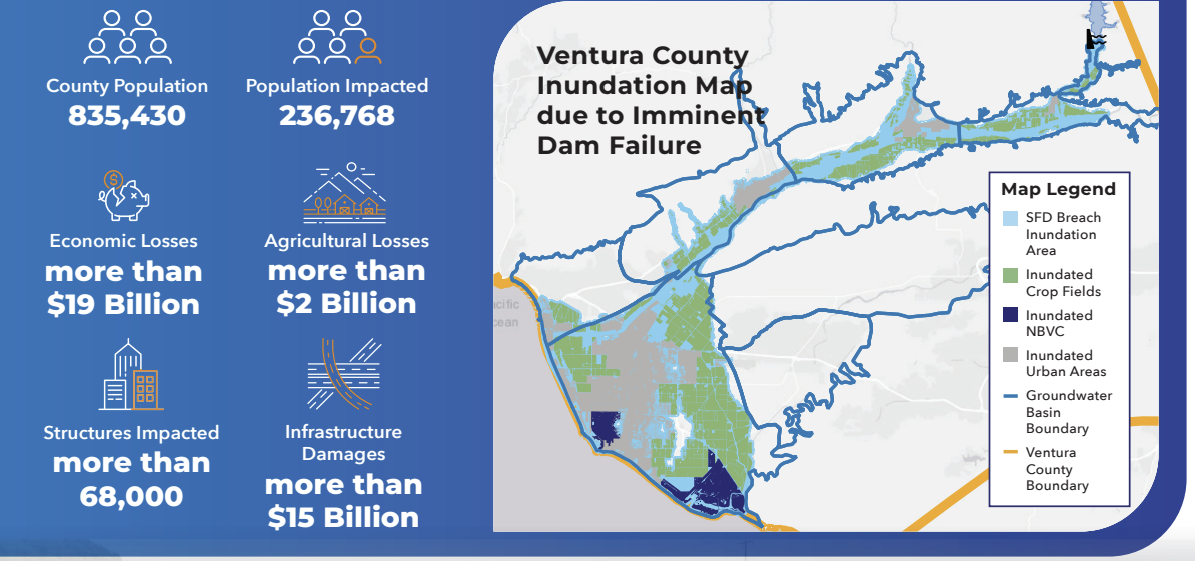
Understanding the Potential Downstream Impact
Inundation modeling helps illustrate how water could move through downstream communities in the unlikely event of a dam failure. The models below show how potential flooding could affect different areas of Ventura County and help demonstrate why the Safety Improvement Project is critical to protecting people, property, and infrastructure downstream.
Piru
- Shows the modeled progression of floodwaters through the community of Piru following a hypothetical dam failure.
Santa Clara River Valley
- Shows how modeled floodwaters could continue downstream through communities and agricultural areas along the Santa Clara River.
Oxnard / Coastal Areas
- Shows the potential downstream extent of inundation as modeled floodwaters move toward the Oxnard Plain and coast.
How the Safety Improvements Reduce Potential Impacts
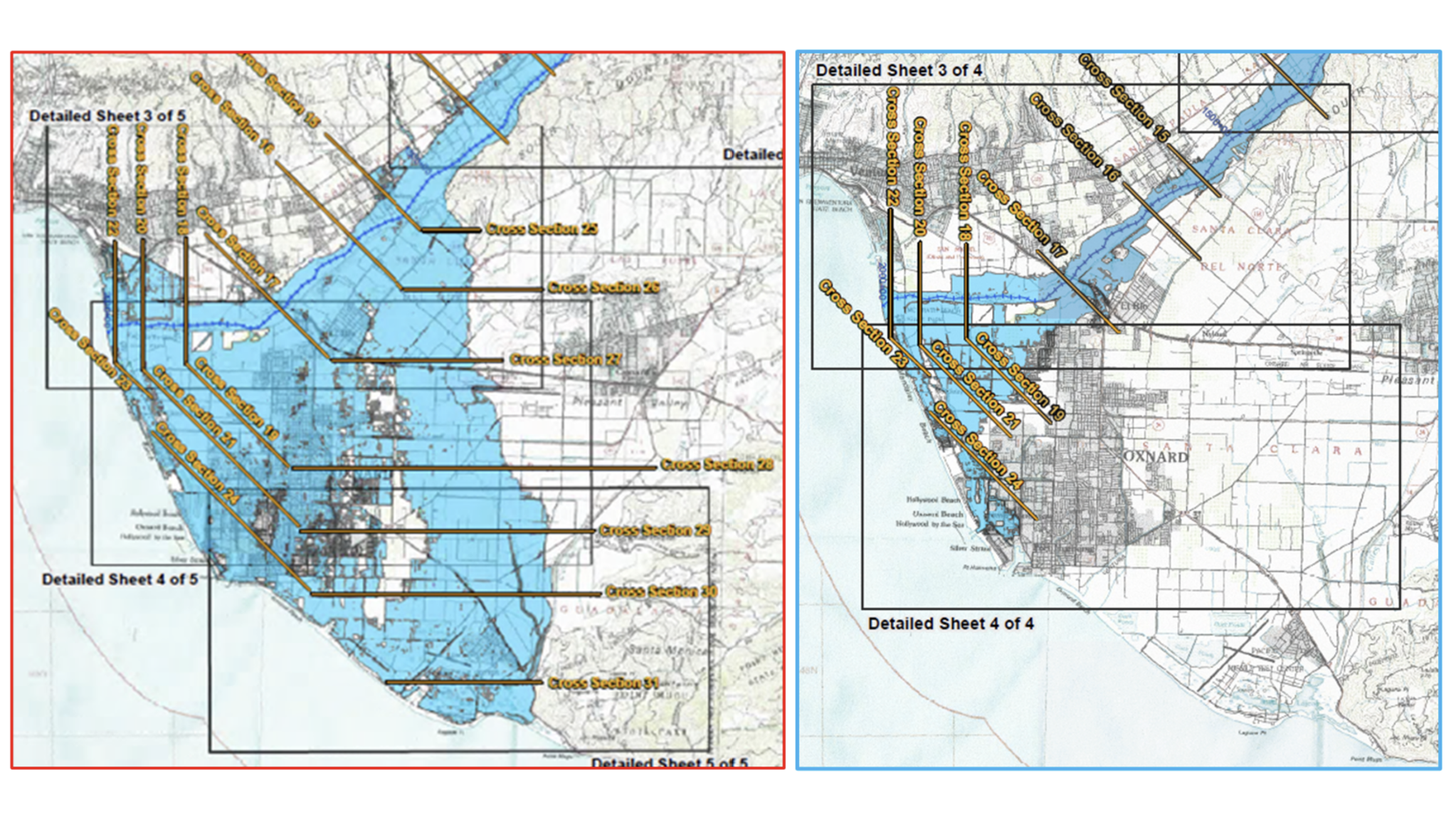
The maps below compare modeled inundation areas under existing conditions with modeled conditions following completion of the Safety Improvement Project. The improvements significantly reduce the extent of potential downstream flooding and associated impacts.
The improvements are projected to reduce potential financial damages by 88%.
BEFORE SAFETY IMPROVEMENTS
Modeled inundation area prior to project completion
AFTER SAFETY IMPROVEMENTS
Modeled inundation area following project completion

A Gap in the Funding Framework
Completing the Santa Felicia Dam Safety Improvement Project will require an estimated investment of approximately $314 million. While United Water has secured funding from several sources, a funding gap remains.
Additional information about project costs and funding can be found below.